ADA-Inspired Luxury Renovations for Manhattan & Brooklyn Apartments

Accessible, High-End Renovations for Manhattan & Brooklyn Apartments
At Star Renovations NY, we believe accessible design and luxury design are not in competition — they are the same goal, viewed from two angles. Across Manhattan co-ops, Brooklyn brownstones, and condo conversions, more of our clients are asking the same question: how do we build a home that looks extraordinary today and still works beautifully if a family member's mobility needs change tomorrow?
This guide walks through exactly how our design-build team approaches ADA-inspired renovation planning — apartment-wide, kitchen by kitchen, and bathroom by bathroom — while keeping a close eye on the codes that actually govern your project, so your filing moves through the Department of Buildings without a costly objection or a stalled approval.
You can also read our blog on when ADA accessibility requirements apply during NYC home renovations and how they affect design, approvals, and building code compliance. https://srny.nyc/blog/ada-understanding-accessibility-requirements-in-nyc-home-renovations

Why Accessible Design Belongs in a Luxury Renovation
Good accessible design is invisible. A curbless shower reads as a spa feature long before it reads as a mobility accommodation. A wide hallway reads as generous flow, not as a ramp in waiting. At Star Renovations NY our job is to design that way from the first floor plan — not to retrofit a beautiful apartment with something that feels clinical later.
- Aging in place: more owners are renovating once and planning to stay for decades, not just for the next five years.
- Resale value: accessible, flexible layouts widen your buyer pool and rarely cost more to build when planned up front.
- Everyday guests: parents, in-laws, and visitors with strollers, walkers, or wheelchairs all benefit from the same clearances.
- Board and DOB confidence: when accessibility is designed correctly the first time, it rarely becomes the issue that delays approval.
Where ADA, NYC Building Code, and Fair Housing Actually Apply
One of the most common points of confusion we walk clients through is which rules actually govern a private apartment renovation. They are not all the same law, and they do not all apply the same way.
- The Americans with Disabilities Act (ADA) is primarily about public accommodations and commercial space — lobbies, leasing offices, amenity spaces, and ground-floor commercial units. A private apartment used only as a home is generally outside the ADA's direct reach.
- The NYC Building Code (Chapter 11) governs accessibility inside residential buildings and sorts units into categories — commonly referred to as Accessible, Type B, and Type B+NYC units — each with its own clearance and fixture requirements.
- Bathrooms that are designed to the highest residential accessibility category typically plan around a five-foot turning radius; bathrooms that fall outside that category still have to satisfy New York City's Appendix P clearance standards for fixtures and doors.
- Reinforced wall blocking for future grab bars is frequently required even when a grab bar itself is not installed at the time of construction — so the wall is ready the day it's needed.
- The Fair Housing Act's design and construction requirements generally apply to buildings of four or more units that received their first occupancy after March 13, 1991; many prewar Manhattan and Brooklyn buildings predate that threshold and are not covered the same way.
- One- and two-family homes are generally not subject to the residential accessibility requirements that apply to larger multifamily buildings.
None of this is a substitute for a licensed architect's code analysis on your specific apartment and building — occupancy, scope of work, and the year your building was constructed all change the answer. What Star Renovations NY can promise is that our in-house architect and project managers flag the right questions early, instead of discovering a compliance issue at filing.

How Star Renovations NY Approaches ADA-Conscious Planning
Every accessible renovation we run follows the same disciplined sequence, whether it's a single bathroom or a full gut renovation.
Read our latest blog on NYC Gut Renovation vs. Partial Renovation
- Building and unit review: we confirm your building's accessibility classification, your board's alteration agreement language, and whether your unit falls under Type A, Type B, or a non-classified category.
- Goals conversation: aging in place, a family member's mobility needs, frequent guests, or simply a more comfortable day-to-day layout — the goal shapes how far we lean into accessible planning.
- Code-conscious floor plans: our in-house architect drafts layouts around real clearances — turning radii, aisle widths, door widths — before a single finish gets chosen, so accessibility is structural, not decorative.
- 3D renderings and finish boards: you see exactly how ADA-inspired choices will look and feel before construction starts, so nothing reads as institutional.
- Board and DOB coordination: we manage filings, expediters, and any required engineering review so the accessibility scope is documented clearly and doesn't trigger a Department of Buildings objection.
- Construction and punch list: tight, on-site supervision protects your finishes and confirms every clearance was actually built the way it was drawn.
If you'd like to see how this fits into a broader renovation, our design-build process keeps one accountable team in charge of design, permitting, and construction from the first sketch to final sign-off.
ADA-Inspired Bathroom Layouts That Still Feel Luxurious
NYC bathrooms are often the tightest rooms in the apartment, which is exactly why thoughtful planning matters most here. We treat an accessible bathroom as a spa-level space first, then layer in accessible planning so it feels effortless rather than added on.
Read our latest blog on Luxury Manhattan Renovation Ideas for Tight Spaces
Key ADA-Inspired Layout Concepts
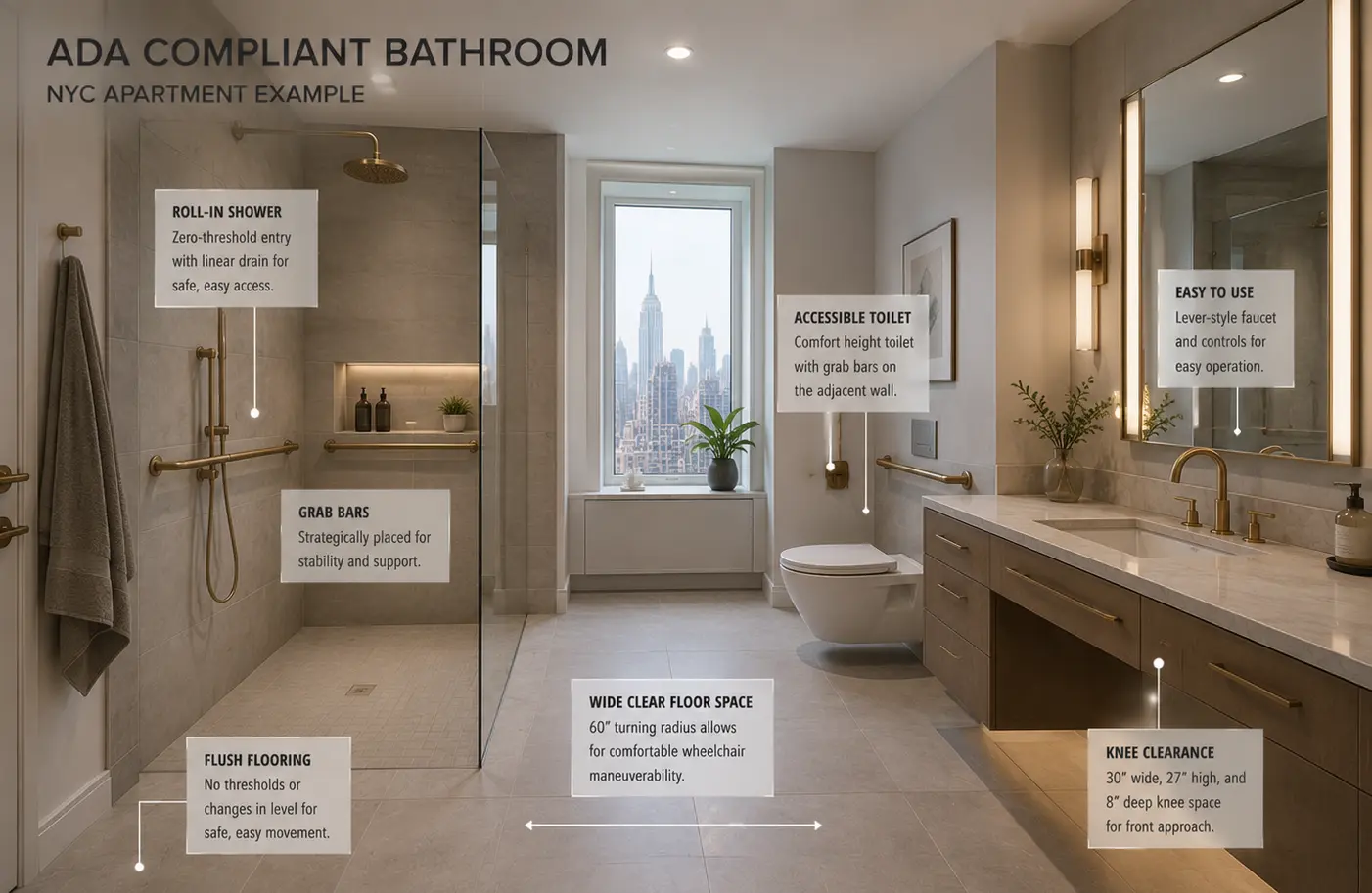
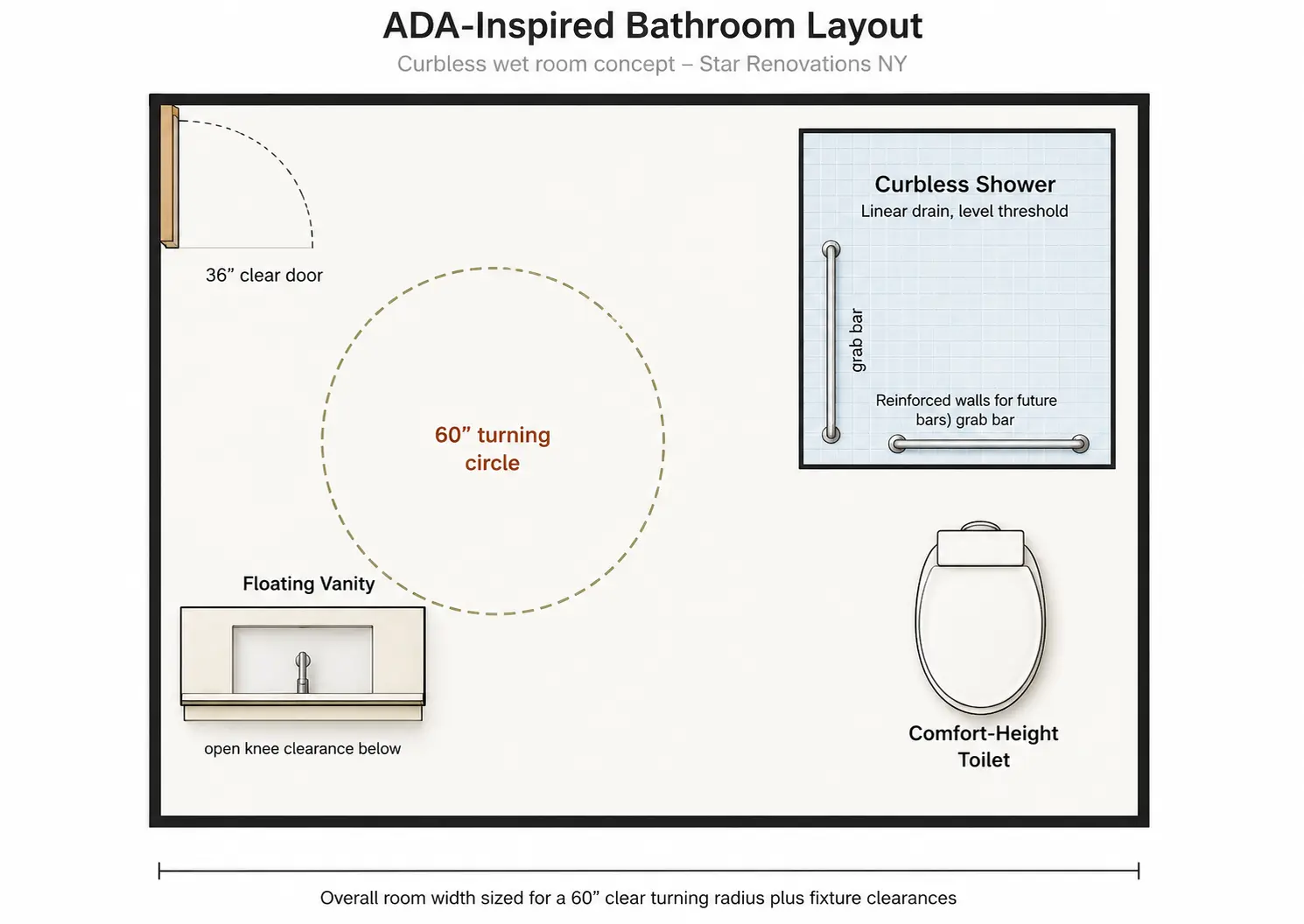
- A clear turning radius, often planned around a 60-inch diameter, for full maneuverability.
- Doors with at least 36 inches of clear width and minimal pinch points.
- Level thresholds and curbless shower entries instead of raised curbs.
- Reinforced wall blocking behind showers and toilets to support future grab bars.
- Comfort-height toilets and vanities that allow front or side approach.
Layouts that work beautifully
- Large wet rooms with curbless showers, linear drains, and continuous stone or large-format tile
- Floating vanities with open knee clearance set at a comfortable height
- Pocket or barn doors that preserve floor area and remove door-swing conflicts
Layouts that almost never comply
- Long, narrow “railroad” baths where the door swings into a tight space
- Step-up tubs or deep shower curbs that block wheelchair or walker access
- Wall-to-wall vanities that eat into turning room or block side access to fixtures
Browse more of our spa-level work on the bathroom renovations page, including tub-to-shower conversions and wall-hung toilet installs that quietly open up floor space.
Accessible Kitchen Planning for Seamless Daily Living
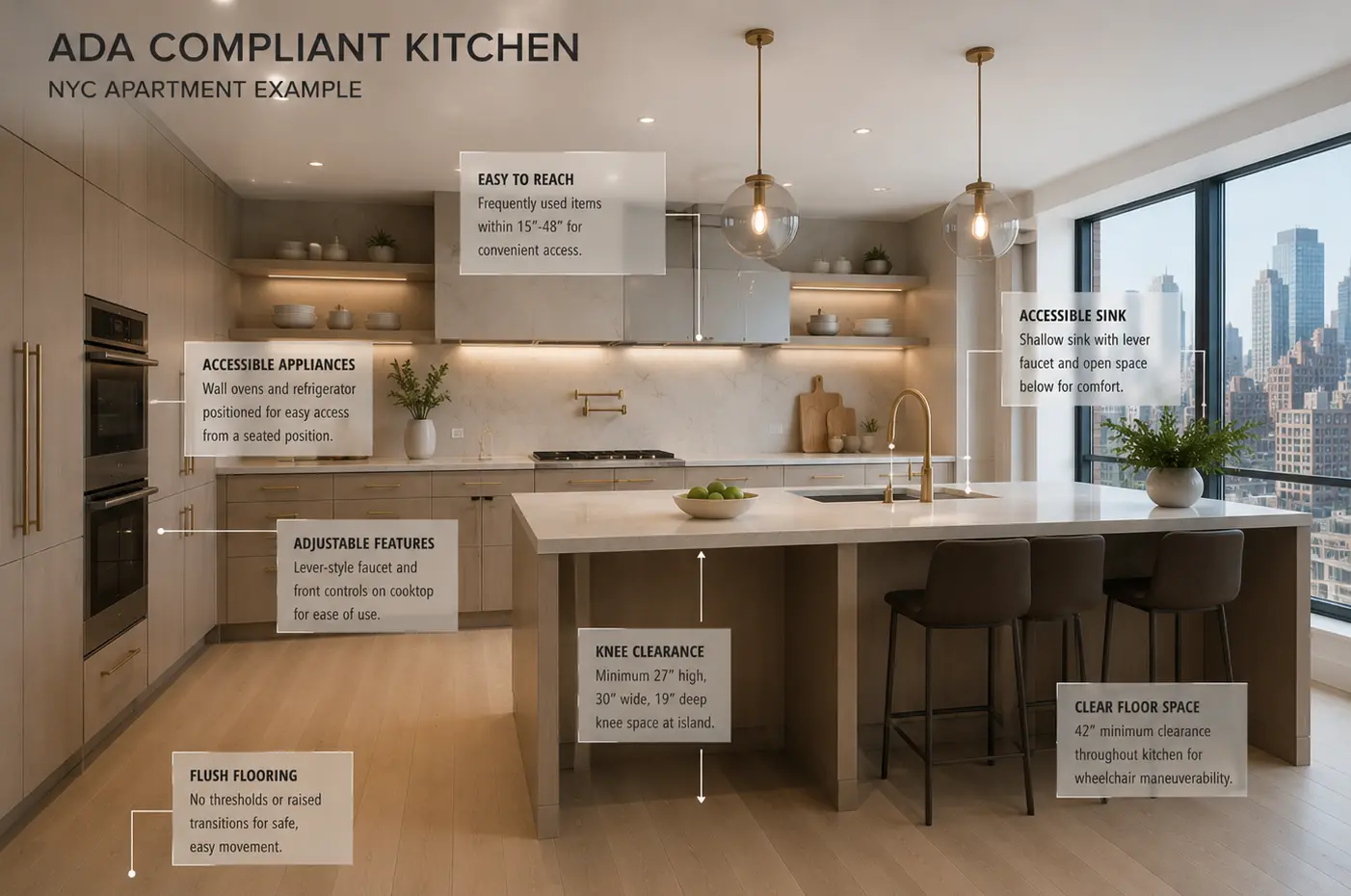
An accessible luxury kitchen is about more than clearances on a drawing — it's about how you actually move, cook, and entertain. ADA-inspired principles focus on clear floor space, reachable controls, and safe appliance placement, and those ideas translate naturally into a high-end Manhattan or Brooklyn kitchen.
Core ADA-Conscious Kitchen Concepts
- A five-foot turning radius where the footprint allows it, or a carefully designed T-shaped turning zone.
- Clear aisle widths of roughly 40 to 60 inches depending on layout and appliance placement.
- Front-control cooktops, side-opening wall ovens, and sinks that can be reached from a seated position.
- Work zones that avoid forcing tight pivots or backing up around obstacles.
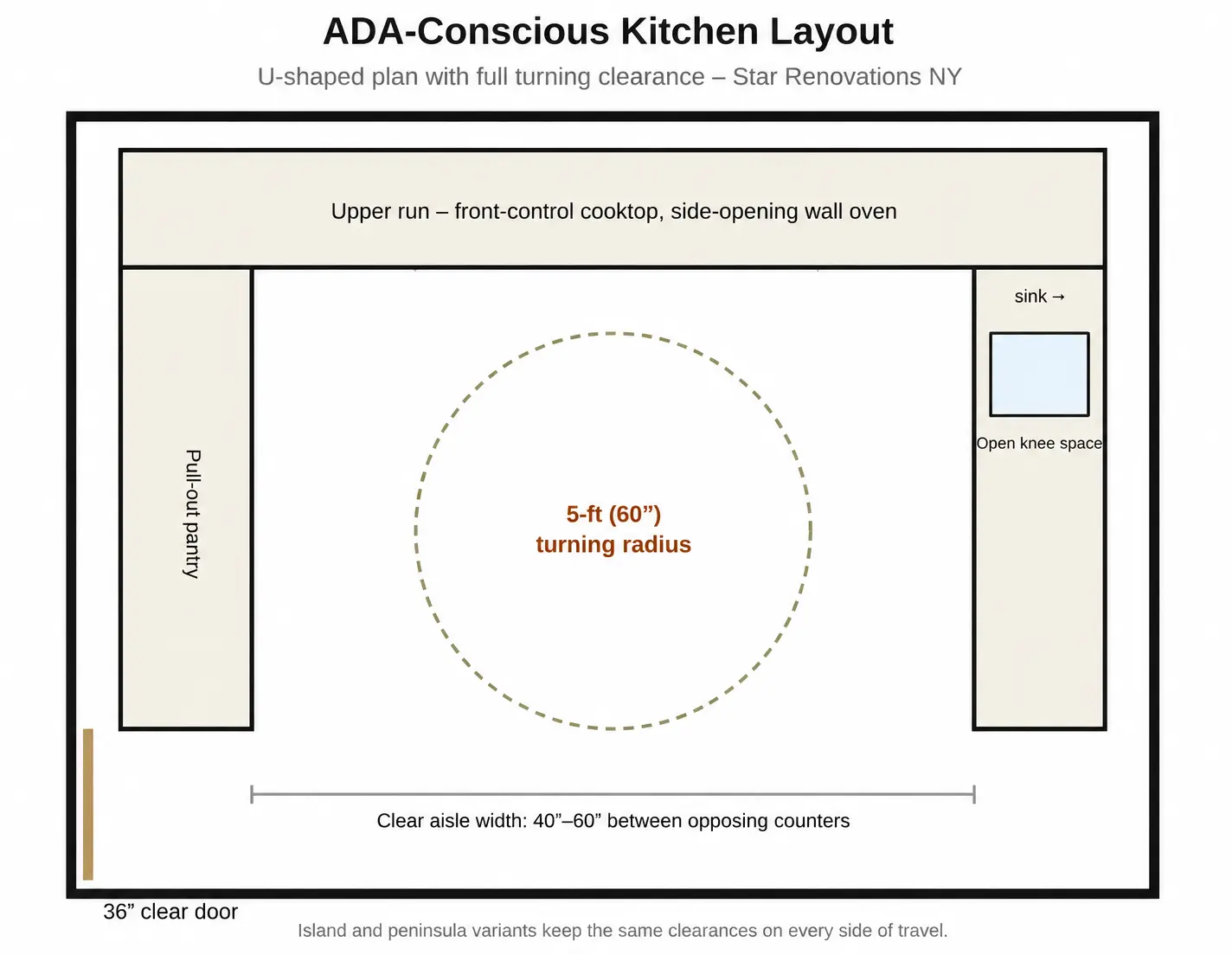
Layouts that support comfort and flow
- L-shaped or U-shaped kitchens with one generous open area for circulation
- Galley kitchens widened to allow passing and a turning zone near one end
- Islands or peninsulas with enough clearance on every side to move and entertain comfortably
Layouts that usually don’t work
- Tight galleys with less than 36 inches between counters
- Islands placed too close to the perimeter, creating choke points
- Sinks, ranges, and refrigerators all crowded into one corner
At Star Renovation NY our designers specify soft-close pull-out pantries, panel-ready built-in appliances, and custom cabinetry tailored to reach and storage habits — see more on our interior renovations page or explore kitchen remodeling on our Manhattan remodeling page.
Whole-Apartment Layouts That Future-Proof Your Home
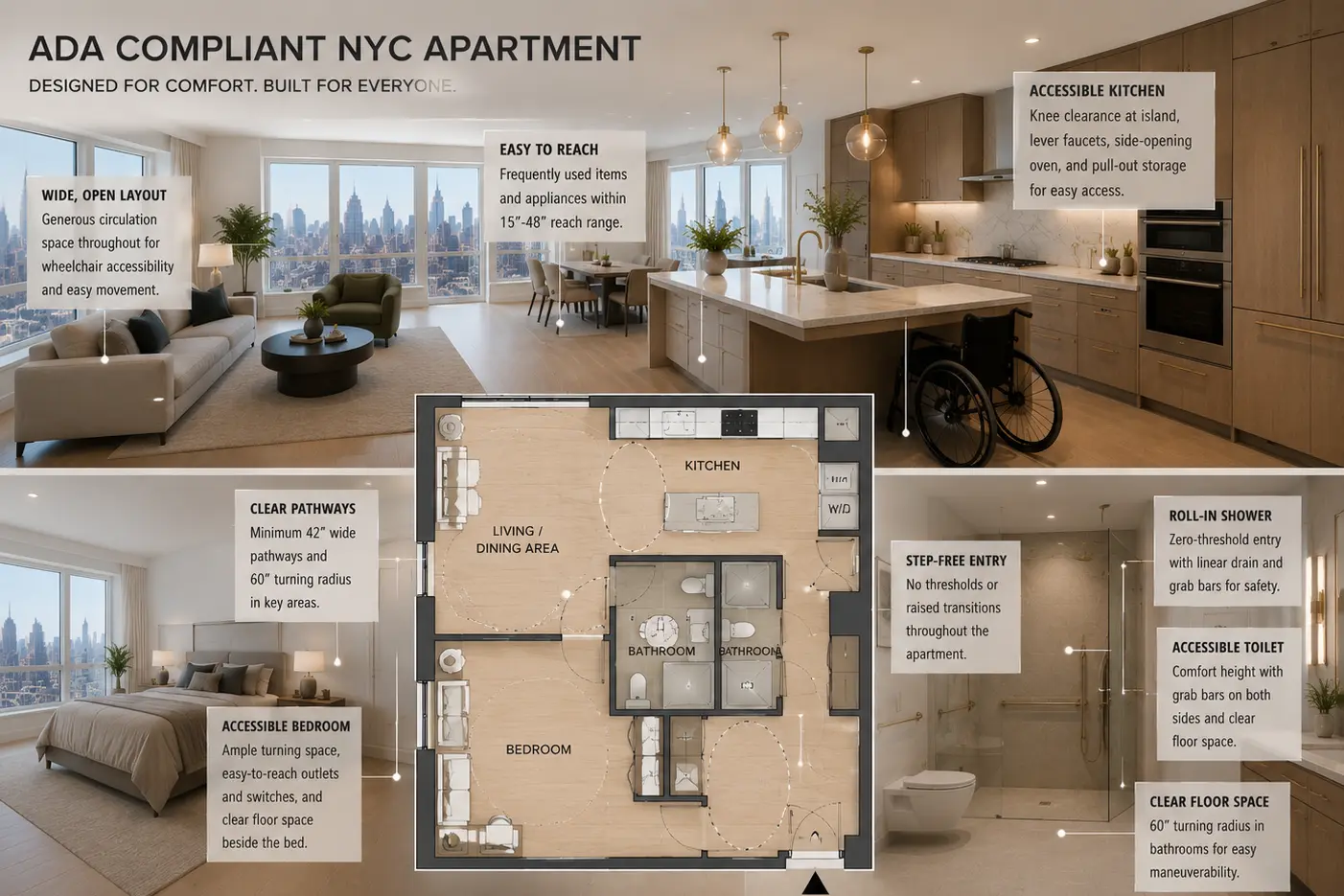
A full gut renovation is your biggest opportunity to future-proof a home at the scale that matters most: how the entire apartment flows, where doors sit, and how rooms connect. Instead of treating accessibility room by room. At Star Renovations NY we plan the whole apartment around a clear circulation spine.
Big-Picture Planning Priorities
- Wider hallways and doorways with as few tight turns as possible.
- Limiting interior level changes so floors stay consistent across living spaces.
- Stacking kitchens and bathrooms sensibly to keep plumbing efficient while preserving clear routes.
- Building flexible rooms that can later serve as a guest room, caregiver suite, or home office.
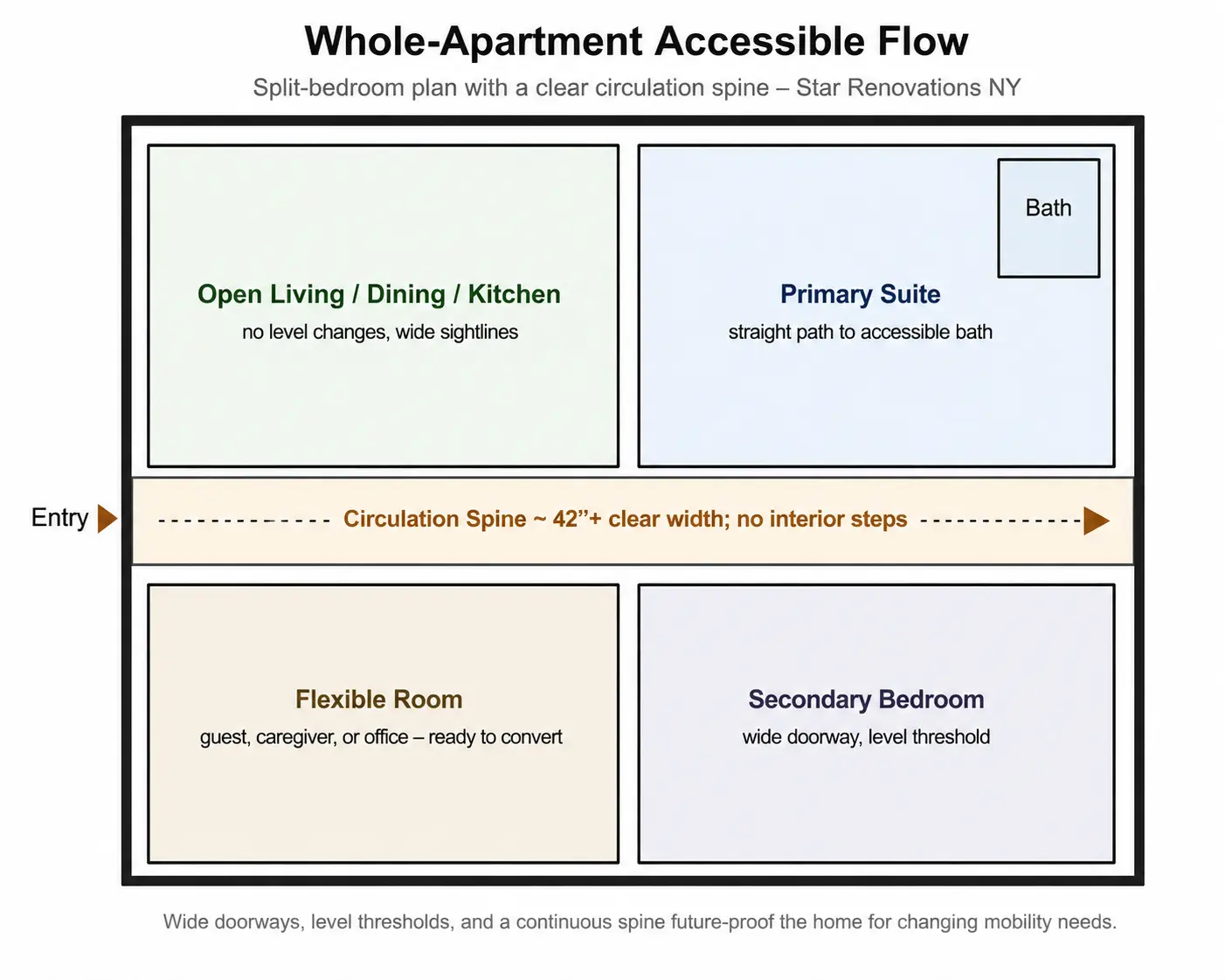
Layouts that support long-term flexibility
- Open living, dining, and kitchen areas with straight, clear paths to bedrooms and baths
- Split-bedroom plans where one suite includes an accessible bathroom and closet route
- End-unit or corner layouts that allow wider foyers and more generous circulation
Layouts that complicate accessibility
- “Railroad” apartments where rooms are chained together in a narrow line
- Interior steps, sunken living rooms, or raised platforms that break up the floor plane
- Over-partitioned apartments with many small rooms and no real circulation spine
If a full reconfiguration is on the table, our co-op apartment renovation design team has deep experience aligning accessible, flexible floor plans with board alteration agreements in prewar and postwar buildings alike. You can also read our broader NYC apartment renovation guide for cost and timeline context before you start.
Avoiding DOB Objections and Speeding Up Approval
Most accessibility-related delays we see come from the same handful of gaps: missing blocking details on drawings, a turning radius that looks fine on paper but doesn't account for a door swing, or a board package that doesn't clearly document which accessibility category a unit falls under. At Star Renovations NY we build our filings to close those gaps before they reach a reviewer.
- Drawings that explicitly call out clearances, blocking locations, and door widths, not just finish selections.
- Early coordination with your board, management company, and any required expediter so accessibility scope is documented up front.
- A licensed architect or engineer of record reviewing the unit's classification before filing, not after an objection comes back.
- A single, accountable design-build team managing design, permitting, and construction, so nothing falls into a gap between separate vendors.

What Our Clients Say
“Eli and the Star Renovations NY team are repeatedly trusted to navigate board approvals and city requirements without disrupting daily life in occupied buildings. One recent client described working with the team through a difficult co-op board approval, full permitting, and a complete renovation that finished ahead of schedule — with zero complaints from building management or neighbors, which matters enormously in a co-op.”
Read more first-hand accounts on our client reviews page, including stories from Manhattan and Brooklyn homeowners who renovated kitchens, bathrooms, and full apartments with our team.
Finding the Right Accessible Renovation Partner in NYC
If you're searching for an ADA-conscious renovation contractor, you're likely typing in some version of these terms — and they're a useful checklist for vetting any firm you're considering, including ours:
- Accessible apartment renovation contractor NYC
- ADA-compliant bathroom remodel Manhattan
- Wheelchair-accessible kitchen renovation NYC
- Handicap-accessible design Brooklyn
- Aging-in-place home renovation New York City
- Curbless shower renovation NYC co-op
- Accessible apartment remodel for elderly parents NYC
Whatever phrase brought you here, the underlying question is the same: can this team deliver a home that's both genuinely accessible and genuinely beautiful, while handling the board and DOB process for you? That's the exact gap Star Renovations NY is built to close.
Read our latest blog on how to Build Your Manhattan Renovation Team, Step by Step